WebXR game2026
Laser XR
An optics lab on a floating grid: lasers, mirrors and prisms, routed by hand.
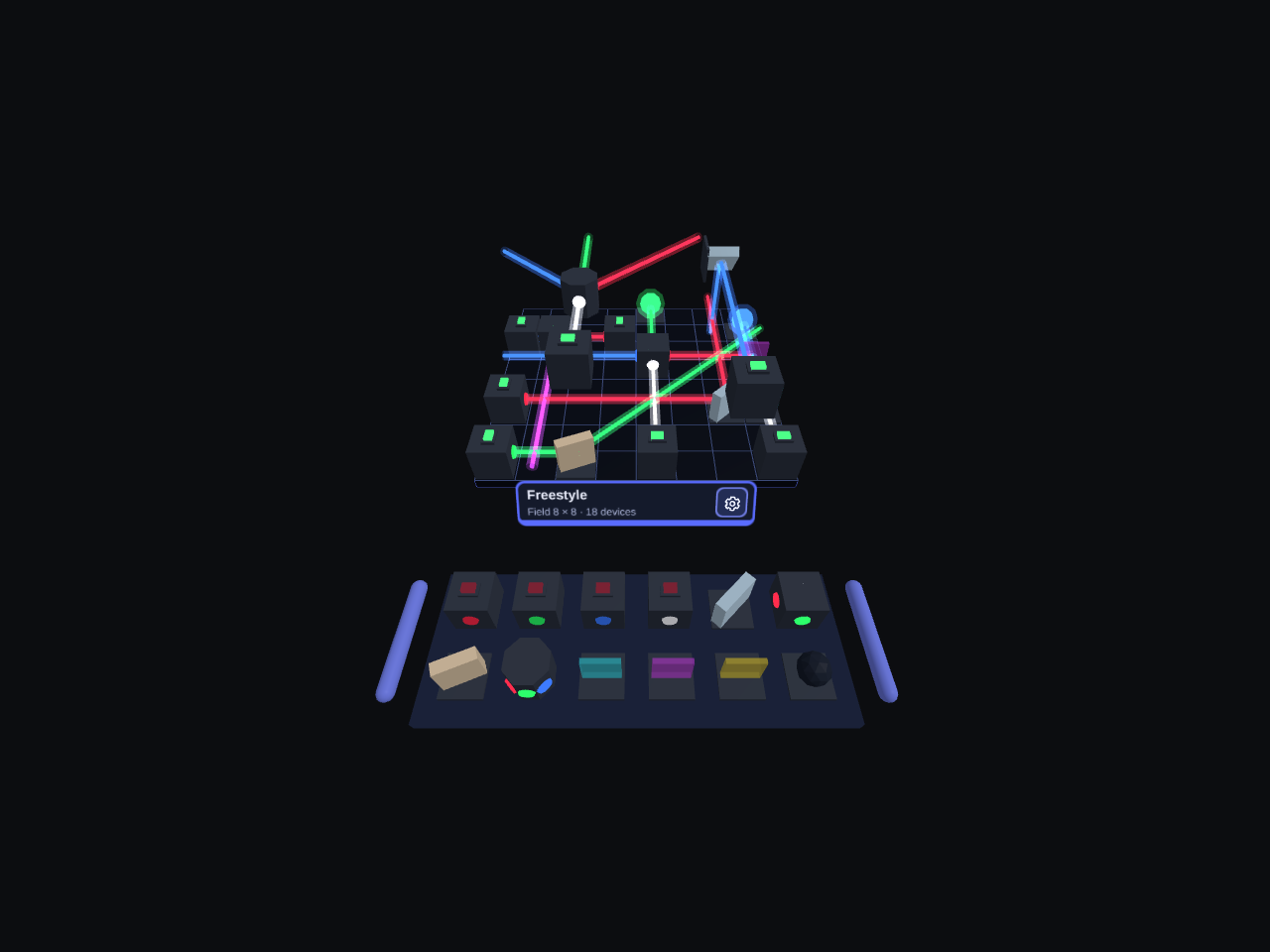
A tray offers lasers in four colours, mirrors, half mirrors, prisms, half prisms, colour-cutting filters and energy cells. Grab a device, carry it over the grid — it snaps to the nearest cell and to whichever of the 24 cube orientations your wrist is closest to — and let go. Lasers fire at the press of the button on their lid, mirrors fold the beams around corners and into the third dimension, a prism is a box with a white port and three coloured ones that splits in one direction and merges in the other, filters each cut one primary colour and chain into any mix, a half mirror bends a beam only half as far — off the axes and onto the grid's diagonals — a half prism fans its colours out at only forty-five degrees through ports on its front edges, and an energy cell glows with whatever light it is fed. Ports and filter glass are strict slots: only a beam arriving straight on gets in, so diagonal light has to be bent back before anything will take it. The whole field is furniture too: grab the bare floor and carry it wherever there is room.
What makes it interesting
- None of it is physics: a beam is a ray walking the grid cell by cell, and each device is one rule for what happens when the walk reaches it — the whole light field is retraced from scratch on every change.
- The prism works in both directions: white into its white port leaves split through the red, green and blue ports, and colours fed into those ports come back out of the white one merged — which makes the trace a fixed-point computation, since one prism's answer can feed another.
- Orientation is part of placement, not a separate mode: the ghost preview shows the exact pose a device would land in, wrist turn and all, before the trigger is released.
- The field is carried the way castle-xr carries its board: it stays level however the wrist rolls, and it pivots about the exact point the ray grabbed, so the far corner never slides out from under the cursor. The tray is furniture of its own, carried by the bars on its sides, and its miniature devices come up to full size the moment a hand picks one.
Forty-eight levels in eight chapters of six, each scored in stars against a par of moves, and a freestyle field beside them.
More pictures
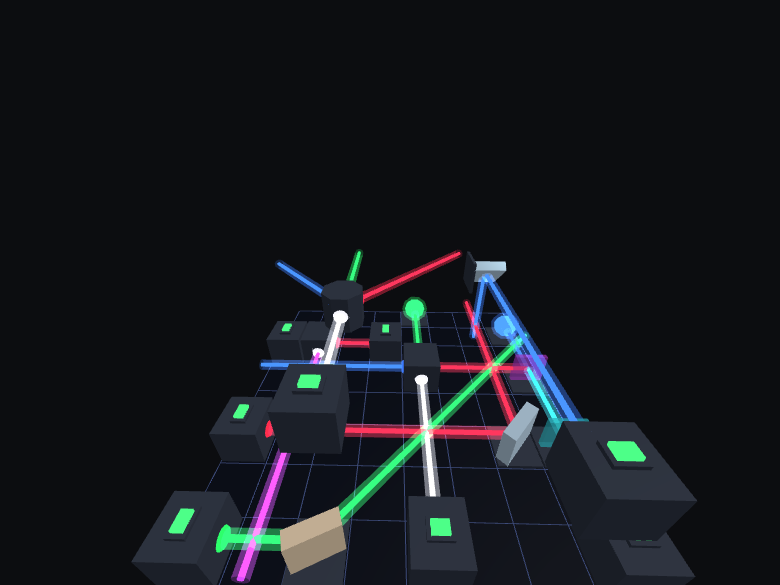
One prism splitting white, another merging red and blue into magenta.